Always-On Campaigning: Why Texting Is the Backbone of a Winning Voter Strategy

Discover how an always-on campaign approach to political texting can enhance voter engagement.

Campaign team working late in an always-on campaign war room
Key Takeaways
  • Always-on beats episodic. Continuous contact keeps a candidate top of mind across the entire election cycle, not just at crunch time.
  • Texting is the highest-attention channel available. 98% SMS open rate vs. 18% for email, and a roughly 90-second average response time vs. 90 minutes for email.
  • The audience is already on their phones. 91% of U.S. adults own a smartphone (Pew Research Center, 2026), and Americans exchanged nearly 2.2 trillion texts in 2024 (CTIA 2025 Annual Survey).
  • Consent is the foundation. TCPA and CAN-SPAM require documented opt-in and a clear opt-out on every political text.
  • Automation makes always-on possible. Workflows and AI-assisted replies let a small campaign team stay responsive 24/7 without staffing every thread.
  • Every message should drive one action. Educate, invite, remind, or get out the vote, with a link that makes the next step a single tap.

What Always-On Campaigning Actually Means

Always-on campaigning is a continuous, year-round approach to voter outreach that keeps a candidate present between elections instead of surging only in the final weeks. Texting is integral to it because supporters opt in once and stay reachable for the whole cycle, on the one device that rarely leaves their side: 98% of US adults own a cellphone and 91% own a smartphone (Pew Research Center, 2026). A campaign that texts consistently builds recognition, trust, and turnout that episodic outreach never delivers.

Always-on campaigning replaces the sprint-and-stop pattern of traditional outreach with a steady presence on the one screen voters keep with them from the first introduction to the final ballot.

Political campaigns borrow this idea from marketing for a simple reason: marketers and campaigns want the same thing, which is sustained attention that converts into action. An always-on approach maintains a continuous flow of relevant communication across SMS, social, email, and events, so a voter can engage with the candidate at any point in their decision, not just when a mailer happens to land.

This is the opposite of a one-off campaign with a start date, an end date, and a fixed number of touches. A congressional cycle, for example, effectively begins the day after one general election and runs to the next, and voters need to be reached and re-reached across that entire stretch. Always-on does not mean blasting people around the clock. It means a calculated cadence that delivers the right message, to the right voter, at the moment it is useful.

DimensionAlways-On CampaigningOne-Off (Episodic) Campaigning
TimelineContinuous across the full cycleShort bursts near key dates
Voter relationshipBuilds recognition and trust over timeStarts cold each time
Message stylePersonalized, occasion-basedBroad, one-size-fits-all
Response capabilityTwo-way, real-timeMostly one-directional
Turnout impactCompounds through repeated contactDepends on last-minute reach
Cost efficiencyHigher (existing opted-in list)Lower (rebuild reach each push)

Why Texting Belongs at the Center of an Always-On Strategy

Texting is the connective tissue of an always-on campaign because it is the only channel that reliably earns attention the moment a message arrives.

Voters carry their phones everywhere, and the numbers reflect it. 91% of U.S. adults own a smartphone and 98% own a cellphone of some kind (Pew Research Center, 2026), and Americans exchanged nearly 2.2 trillion text messages in 2024 (CTIA 2025 Annual Survey). Texting is not a niche tactic; it is where people already communicate. Against that backdrop, SMS outperforms the alternatives on the metrics that decide whether a campaign message is actually seen.

ChannelOpen / View RateTypical Response TimeTwo-Way?
SMS98%~90 secondsYes
Email18%~90 minutesLimited
Social mediaAlgorithm-dependentVariablePublic, not private
Phone bankingLow pickupLive, if answeredYes, staff-intensive

Open and response figures above are from the 2026 EZ Texting Consumer Texting Behavior Report. The response gap is just as decisive as the open gap: the average text draws a reply in about 90 seconds, while the average email takes roughly 90 minutes. In a compressed election window, that speed is the difference between a reminder that lands before the polls close and one that arrives too late to matter.

Texting also enables genuine two-way conversation, so a campaign can answer a voter's question about a polling place or a policy position in real time. That back-and-forth is where recognition turns into relationship. A voter who can text a question and get a straight answer feels seen by the campaign, and that responsiveness builds the kind of trust and loyalty that a broadcast email never will.

Here is our position: email has quietly stopped working as a persuasion channel, and campaigns that wait until the final get-out-the-vote window to start texting have already forfeited the months of relationship-building that decide close races. Always-on texting is not a nice-to-have layered on top of the "real" campaign. It is the channel that holds the whole cycle together.

Building a Political Texting Cadence That Runs the Whole Cycle

A strong always-on texting program moves a voter through distinct stages, from first introduction to a final election-day push, with each message built around a specific occasion.
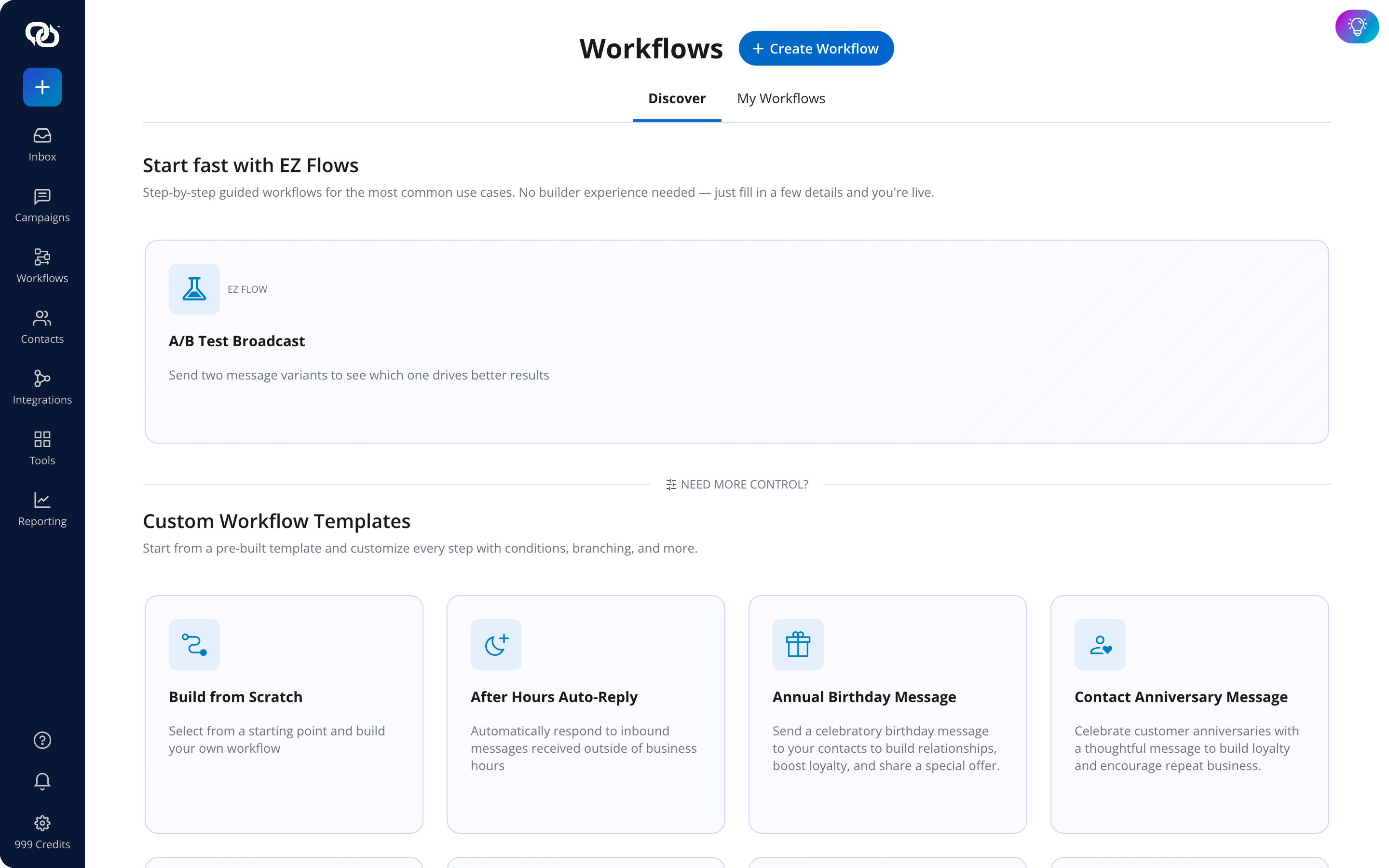
EZ Texting Workflows automated-reply builder

EZ Texting Workflows trigger automatic replies, keeping outreach going 24/7 without a person watching every thread.

The goal across the cycle is a voter who feels informed and motivated enough to show up and vote. That happens through sequenced, purposeful messages rather than random blasts. A typical cadence moves through four phases: educate early in the cycle (introduce the candidate and platform), invite mid-cycle (drive event attendance and volunteers), remind before the election (prompt early voting and registration), and get out the vote on election day (convert support into a cast ballot).

Sample messages across the cycle:

What your customer receives
Hi {first_name}, curious where Maria stands on local schools? Here's her 2-min plan: {link}.Reply STOP to opt out.
You're invited: town hall with Maria this Thu 6pm. RSVP by Tue for a free tote: {link}.
Early voting is OPEN in {county}. Find your site and hours here: {link}.
Today's the day. Polls close at 8pm. Your polling place: {link}. Thanks for voting!

Notice that each message earns its place with a clear action and a single tappable link. An educational text might point to a blog post on the candidate's climate stance, complete with an infographic and short video so the voter can go as deep as they want. An event invite can offer a small incentive to those who RSVP by a deadline to lift attendance. And the closing sequence, a reminder when early voting opens, a follow-up the day before, and a final push on election day with polling times and locations, is where a well-run cadence turns months of engagement into votes.

Best Practices for Compliant, High-Engagement Voter Texting

Effective political texting rests on three disciplines: get consent, personalize relentlessly, and let automation carry the load.
Illustration of one icon, a political campaig, and/or entity with arrows extending to several smaller icons representing contacts

Illustration of one icon, a political campaig, and/or entity with arrows extending to several smaller icons representing contacts

Stay compliant. Before texting any voter, campaigns must understand the rules that govern outreach, including the TCPA and CAN-SPAM Act. In practice this means obtaining documented consent before messaging and including a clear opt-out (typically "Reply STOP") in campaign messages so a voter can end contact at any time. Compliance is not just legal cover; a clean, opt-in list protects deliverability and the campaign's reputation.

Personalize every message. Generic texts get ignored. Tailoring outreach by demographics, location, and expressed interests makes each message more relevant, and relevance drives engagement. A voter who receives information about their specific polling place, or about an issue they already care about, is far more likely to act than one who gets a mass, undifferentiated blast.

Automate the always-on part. No campaign can staff every text thread around the clock, and it does not need to. EZ Texting Workflows trigger automatic replies and sequences, keeping outreach running 24/7 without a person watching every conversation. AI features push this further: AI Compose helps volunteers write on-brand messages quickly and drives a 30% increase in SMS response rates, while AI-assisted replies can answer common voter questions instantly. Automation does not depersonalize outreach; it personalizes it at a scale a volunteer team could never match by hand.

Mobile Advocacy: Turning Messages Into Action

Mobile advocacy uses texting and mobile tools to make participation effortless, converting attention into petitions signed, voters registered, and ballots cast.

Split-screen of 2 - 3 different-looking people reading a text on their smartphone

Split-screen of 2 - 3 different-looking people reading a text on their smartphone

Mobile advocacy means meeting voters where the friction is lowest: their phones. When registering to vote, signing a petition, or answering a poll is one tap away, participation climbs because the effort collapses. Instead of sending canvassers door to door to collect petition signatures, a campaign can send a mass text with a link to an online petition. Instead of hosting a large in-person registration drive, it can text a short tutorial on registering to vote online. Each of these swaps a high-effort task for a few clicks, which is exactly how always-on outreach compounds into measurable turnout.

The same logic applies to feedback and momentum. A quick text survey or poll gives a campaign real-time read on where voters stand, and a link to a livestreamed Q&A or a volunteer signup turns passive supporters into active ones. Because every one of these actions starts from a text the voter already opened, mobile advocacy closes the loop between a message sent and a step taken, which is the whole point of running an always-on program in the first place.

Frequently Asked Questions About Always-On Campaigning

Always-on campaigning is a continuous approach to voter outreach that keeps a candidate present throughout the entire election cycle rather than only in the final weeks. It maintains a steady flow of relevant, personalized communication across channels like SMS, social, and email. The aim is to build recognition and trust over time so voters are informed and motivated by the time ballots are cast.

Texting is essential because it reaches voters faster and more reliably than any other channel. SMS sees a 98% open rate compared to 18% for email, and 87% of consumers read a new text within 15 minutes (2026 EZ Texting Consumer Texting Behavior Report). With 91% of U.S. adults owning a smartphone (Pew Research Center, 2026), texting meets voters exactly where they already are.

Yes, when done correctly. Campaigns must follow the TCPA and CAN-SPAM Act, which require documented consent before texting and a clear opt-out on every message. Obtaining written opt-in and honoring "Reply STOP" requests keeps a campaign compliant and protects its message deliverability. Consult current federal and state guidance, since political texting rules can change.

Frequency should match the phase of the cycle and the value of each message, not a fixed quota. Early on, educational messages can run less often, while the final week before an election warrants reminders about early voting and polling locations. The rule is simple: every text should carry a clear purpose and action, so voters see contact as useful rather than noise.

Effective campaigns send four core message types: educational texts that introduce the candidate and platform, invitations to events and volunteer opportunities, reminders about registration and early voting, and get-out-the-vote pushes on election day. Each message should include a single tappable link to the next step. Personalizing these by location and interest sharply increases engagement.

Automation is what makes a 24/7 presence realistic for a lean campaign team. Workflows trigger automatic replies and scheduled sequences so outreach continues without someone monitoring every thread, and AI tools like AI Compose speed up message writing while lifting response rates by 30%. This lets a small team stay responsive to voters at any hour, which is the essence of the always-on approach.

Keep Your Campaign Present, From Now Until the Ballot

An always-on texting strategy keeps your campaign present, responsive, and top of mind through every week of the cycle, not just the final push. Start your free 14-day trial with EZ Texting and keep your voters within reach until the last ballot is cast.

See other related to Industries:

See other related to Features:

See other related to Use Cases:

See other related to Topics:

14-DAY FREE TRIAL
Take EZ Texting for a Spin
The easiest way to add SMS to your business. No credit card required.
1,000+ five-star reviews

Join the 230,000+ Who Have Used EZ Texting to Connect with Their Audiences.